McAuley - The Grinning Mirror
James McAuley on poetry, modernity, Catholicism, and Australia

James McAuley, born in Lakemba, Sydney, was a poet, academic, journalist, literary critic, organist, and convert to Catholicism. He was co-conspirator to Harold Stewart in Australia’s most famous literary hoax. Both men were sometime students of Guenon and Coomaraswamy; the influence is present in the following article.
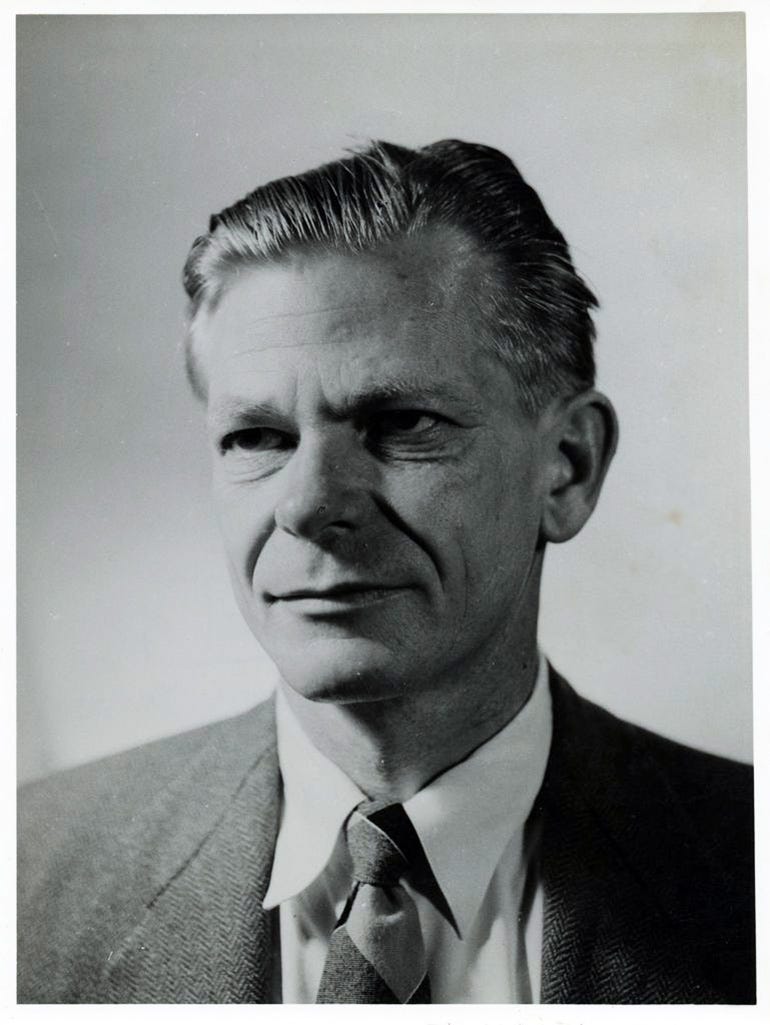
James McAuley in the Australian Dictionary of Biography
I
Hans Andersen’s story The Snow Queen opens with a parable concerning the “enlightened” mentality of his own time and ours. A wicked sorcerer made a mirror whose grinning face had the property of reducing the good and beautiful almost to nothing while it accentuated everything worthless and ugly. “All who attended the school of magic related everywhere that a miracle had happened, and that now, for the first time, one could see what man and the world really were. They ran about everywhere with the looking-glass till at last there was no man and no country that had not been distorted by it. Not satisfied with this, they flew up towards heaven with it; but the looking-glass shook so violently with its own grinning that it slipped out of their hands.” The shattered pieces and particles fill the air; and “whoever got them in his eyes saw the whole human race distorted, for each particle, however small, retained the peculiarity of the whole looking-glass. Some men even got a small piece of the glass in their hearts, and that was dreadful, for the heart became like a lump of ice.” Some of the pieces of this ideological speculum were made into spectacles – by which may be understood particular philosophical systems – “and then indeed all went wrong, particularly when people put them in order to see right and to be just.”
With this parable by way of frontispiece I want to make some observations concerning the relation of poetry to ideology with particular reference to Australia.
II
When one looks at the modern Western nations one may be struck by the fact that for each nation some particular period of its history seems to have been decisive in fixing or crystallizing not only its institutional forms and traditions but even more its basic outlook, national mentality, cultural pattern. Modern England, for example, came into existence in the seventeenth century. Much has changed since, many new influences have been at work, yet the matrix of English society and culture can still be dated as seventeenth-century. For the United State the decisive period is a century later than this: its institutions and outlook preserve a recognizably eighteenth-century cast. For France the critical period, fateful for the national composition, was the Revolution and the Napoleonic aftermath.
The critical moment at which the matrix of the modern national culture is formed may be identified in the following terms it is the moment, after the major national upheaval or traumatic experience, when a constitutional and cultural settlement is reached, representing the relative strengths of the old traditions of Western civilization on the one hand and the forces of “modernity” on the other. I must apologize for using the term “modernity” in a special way here, following as I am the line of historical analysis traced out by Eric Voegelin in his very important study of political ideas.[1] By “modernity” is meant anti-Christian illuminism or Gnosticism seen as a movement which has developed over many centuries in ever more secularized forms. It may be said to have its official opening with the line of speculation developing from Joachim of Flora in the Middle Ages, whereby Gnosticism took the form of expectation of a new, a third and final age, the Age of the Spirit succeeding the Ages of the Father and of the Son: a cosmic New Order, or Third Realm, of liberation and enlightenment – liberation from the present institutional pressures of Church and State, enlightenment by paracletic insight into the mystery of the world. This theme is like an underground stream that waters the roots of the many later movements, emerging in the sixteenth and seventeenth centuries in the theocratic and millenarian sectaries of the Protestant revolution. By the eighteenth century the gnosis has been secularized to the point at which a final state of human perfection is seen to be approaching as the end-result of inevitable Progress through rationalist Enlightenment. Only those who imagine that secularist thought can originate anything will be surprised by this gnostic pre-history. In the nineteenth century the Christian residues that remained in this body of ideas are systematically expelled under the action of naturalism, scientism and materialism, so that in the twentieth century “modernity” stands forth in brutal self-confidence as atheist, technolatrous, ruthless totalitarianism, whether expressed in the Hitlerian Third Reich (which was to last one thousand years) or in the Marxist programme for a third and final era which shall bring man to a new synthesis, beyond the thesis and anti-thesis of what has so far constituted history. Meanwhile, of course, alongside this triumphant unabashed pure “modernity”, representatives of earlier levels of “modernity” survive, advocating older mixtures and compromises, frightened and bewildered by the more highly-evolved recent forms of inevitable Progress, yet implicated, and often fascinated and drawn along by them. In this camp of the modernists of yesteryear (secularists, humanists, liberalists, progressivists) there is nowadays to be heard much talk of the need for a “third force” – of a “middle way” that these heirs of the Enlightenment intend to tread between right and wrong, truth and lies, sense and nonsense, honour and dishonour. Non ragionam di lor, ma guarda e passa.[2]
The point made by Voegelin is that the cultural complexion of a modern nation depends on how early or how late it experienced the traumatic breakthrough of the forces of “modernity” and reached a settlement. England had its decisive experience early, when the traditional culture and institutions were still vigorous and the forces of “modernity” still in a semi-Christian form; hence the relatively strong traditionalism and stability of later English developments, even in spite of the extraordinary ravages of positivism and empiricism in its intellectual life. The United States crystallized with a different balance of forces, less traditionalist yet retaining natural-law doctrine and other important basic elements. When we come to France of the post-Revolutionary period we are struck by the fact that the type of “modernity” which had broken through was now so militantly and self-consciously anti-traditional that no compact between the contending mentalities was possible. Still more violent has been the breakthrough in modern Russia and Germany. And now the Oriental civilizations are experiencing similar crises in their encounter with “modernity”, the consequence of which cannot be foreseen.
Can Australia be placed in this scheme of analysis? It seems to me that there is a basic Australian compact, a national complexion, but that this has come about in the course of a different sort of history from that of the other countries mentioned, a history which contains no national revolution, no major traumatic experience. In consequence the national matrix, its cultural idiom and political style, came to be fixed rather gradually and unobtrusively; the critical period being, I should guess, prolonged over the years between the attainment of colonial self-government and the emergence of the Labour Party. The sudden influx of immigrants during the gold-rush and the heightened class-war of the following decades were perhaps somewhat traumatic in their effect.
The matrix thus formed has as its predominant element what constituted “modernity” in Western civilization in the second half of the nineteenth century, namely the tendencies represented by the terms liberalism, positivism, naturalism, agnosticism, materialism, pantheism, panvitalism, secularism, nationalism, socialism, progressivism. These strands of tendency were the more securely woven into the pattern because they did not come up against the same resistances of long-established social institutions and sentiments which they met in Europe. The bright side of this is that, by a fixation at this stage, important residual elements of genuine civilization (for example, the Common Law, the parliamentary method, humanitarian sentiment) entered into the national outlook and institutions. By traditional standards we may indeed be far gone in “modernity”; but yet by comparison with twentieth-century levels of Progress our nineteenth-century heritage is reassuringly old-fashioned. We have Christian residues in our thinking that we have not thought it necessary to expel. Also, our historical experience is still rather limited and provincial. Pure demoniac evil is rare amongst us, and leaves us baffled and incredulous. Our ambition is to put Christ through a state-school course in Social Studies, not to shoot Him. New Australians coming to our shores feel the absence in our secular culture of anything corresponding to the more ancient traditional residues of Europe: we are thus “new” and “raw” to them from one point of view. Yet in our inexperience with regard to true nihilism and extreme spiritual corruption they find us naïve and old-fashioned, as if living behind the times.
In a world such as now exists, we may count ourselves on balance fortunate in our culture and polity. The notions of right and of value current among us may be defective and unstable, but they could be worse, and are fixed in our mentality to an extent that can best be explained by the hypothesis I have put forward of a privileged period of crystallization in which certain formulae and compromises become, so to speak, consecrated. Our cultural matrix resists rather better than one might at first fear both the simpering nihilism of our positivist professors and the corrosion of the Communist vanguard.
To what extent, it will be asked, can we attribute to authentic traditionalism a counterbalancing share in the Australian compact? By this I mean those elements which effectively retain all or most of the traditions and doctrines of Christendom. So far, our historians have tended to emphasize the elements of “modernity” in our make-up and to play down or ignore the traditional elements; and their interpretations have been on principles drawn from a whig-secularist or leftist background of thought. This approach, we may hope, will gradually be corrected by others. Nevertheless, I think one must conclude that the effective influence of a large minority rooted in Catholic traditions has not been as fruitful as might be wished, because of a number of factors which tended to restrict its action. Certainly, Catholic influence has been effective at certain points where it has reinforced the strength of those elements of Christian tradition which remain diffuse in the community at large. It has also, by its obduracy on some issues, tended to set limits, through abstention or opposition, to some of the more extreme tendencies of “modernity” – especially within the working-class milieu, where the Catholic Irish mainly found themselves. That it has not done more is not really surprising. The Catholic body was for a long time located well down in the social scale. While the secularist and sectarian attack on the conscience of Catholic parents and their children was resisted with admirable zeal and self-sacrifice by the creation of a primary and secondary school system, there were no tertiary institutions in which intellectual life among the laity could be brought to maturity. The result was that those who advanced to a sophisticated professional and secular culture too often possessed a grasp of doctrine appropriate to a child of fourteen and were unable to bring the one into relation to the other.
Moreover, Australian Catholicism was largely incapsulated in Irish nationalism, which reduced its radiating power beyond the Irish-Catholic minority. Furthermore, the Catholicism of the proletarianized Irish of the dispersion was, during the critical late nineteenth-century period, in all countries subject to certain limitations and defects. While exhibiting a most admirable collective loyalty to the Church, as well as a genuine individual piety, it shared in that general tendency of the modern Catholicism of the period to draw on only a part of the illimitable treasury of the Faith. The movements that were at that time beginning towards the recovery and development of a richer theology, a deeper liturgical life, a renewed scholastic philosophy, and an adaptation of ancient principles to the reform of modern political and industrial evils, had not yet penetrated very far into the consciousness of the Australian Catholic community. The result of all this was the tendency of the Catholic to adhere loyally in private to the practice of the Faith but to be influenced, guided and determined in secular affairs mainly by sentiments, attitudes, movements and fashions which were accepted so long as their latent anti-Christian implications were not too blatantly revealed. In this way the Catholic contributions to politics, business, academic life, literature and art left much to be desired. Nevertheless, the last word on the subject must be one of admiration and gratitude for what was achieved under great difficulties. And there are signs of the emergence, even though on a small scale as yet, of a more plenary Catholicism sending its ray deep into the tissues of the surrounding secular civilization.
III
For poetry, the consequences of this fixation of the Australian cultural matrix at a late nineteenth-century level of Progress and Enlightenment have been unfortunate.
Poetry is always closely related to the cultural matrix. Even if the poet does not deliberately set out to exemplify the basic ideas and valuations of his society – and he does sometimes do this – he will without thinking about it reflect those ideas and valuations with greater or less fidelity in his work. Even if he sets himself in opposition to his time, it becomes apparent to later eyes how much he remains nevertheless a child of his time. But there is more to it than this: there is much that is obscure and hard to analyse. The words and images of poetry must have a certain irradiation; they gain their effect by arousing a murmuring echo of response in the audience’s mind; they have overtones of significance, an aura of association and suggestion, which they acquire because behind the simple words stands the whole resonant organism of a particular society, with its memories, its beliefs, its values, its habitual sentiments. The greatest poetry is always the result not merely of individual genius but of the interaction between individual genius and a particular culture. I am not suggesting that there has to be a complete harmony of univocity between them; indeed a certain tension seems to be fruitful as well as inevitable. But it is easy to see that if the cultural context is impoverished and unfavourable even the highest individual genius will suffer some impairment and frustration. If, for example, the language has been degraded, devitalized and desecrated by advertising, journalism, ideological propaganda, scientism, including social-scientism, and mass-production schooling, the poet may still, by incredibly efforts and austerities, make some of the language work poetically, but he would have been able to do much more if he had a more living language to use, not something that feel like chewed paper or tired chewing-gum in the mouth.
Now I have elsewhere drawn attention to the fact, which is not as widely understood as it should be, though obvious enough, that the mental climate or atmosphere created by Progress, Enlightenment and “modernity” is very unfavourable to poetry. The relationship between poetry and this atmosphere can in fact be stated very simply: it is the same as that between a dog and a gas-chamber. There is no genuine poetry which expresses the mentality of Locke, Hume, Bentham, Comte, Marx, Mill, Spencer, to name a representative few. There is no genuine poetry which celebrates the world as Beatrice Webb, Shaw, Wells, Bertrand Russell, Laski or other gurus of recent times have seen it.[3] To come to Australia: there is no genuine poetry which corresponds to the “modernity” present in our heritage. There are, indeed, varieties of sub-standard verse rhetoric which have been used by the bards of Federation, of Utopia, or Nationalism, and more recently of Latterday Leftism. The value of this mass of material may be judged at once by a glance at the work of the most distinguished of the Austral bards of Progress, Bernard O’Dowd. His work is a cloaca maxima into which has flowed all the ideological drivel of the nineteenth century – deism, pantheism, nationalism, socialism, democratism[4] and the rest – and its value as literature is nil.
The reason for this lethal effect of naturalism, secularism, utopianism and so forth on poetry is that genuine poetry is always realistic in the proper sense of the word: it bears some proportion to reality, it does not utterly mistake the nature of man and of the world. Erich Heller[5] put this very well in a broadcast talk on poetry: “It is concerned with the true stature of things. And being concerned with the true stature of things, all great poetry is realistic.” People who wear spectacles made from the great sorcerer’s looking-glass cannot see things in their true stature. No amount of mental energy or passion, no manipulation of the techniques of poetry, no tall terms of rhetoric, will produce work that has dignity or beauty or depth or joy. These qualities can emerge only when the mind plays false to its official views and somehow gets at least partially into contact with reality.
The question arises whether the orthodox Christian component in our heritage may be regarded as a resource for poetry. In principle, yes; but the cultural limitations of modern Catholicism which have been already pointed out must be taken into account here too. The Australian Catholic shares inevitably in the prevailing mood, tone, sentiment and attitude of the rest of the nation, so that he is to that extent out of touch with poetry. In addition, there are disconcerting features of his own heritage as it has come down to him. Over the last few centuries, under the stress of many difficulties, Catholicism has tended to lose contact with the earlier and better cultural traditions that developed under its influence. In the externals of its life it has accepted styles and idioms of art and language which are really unfit for its purposes; and having accepted them it has clung to them with the conservatism which is normal in religious matters. Thus instead of the grandeur and purity and tenderness of the older authentically Christian modes of expression, Christianity became disguised and deformed by the habitual use of Renaissance and post-Renaissance modes whose origins lay in naturalism and secularism, culminating in the nineteenth century in the loathsome commercial religious art with which we are still familiar and in the rococo pieties of devotional manuals. An imagination contaminated by these external modes cannot easily purge itself and recover purity of vision. It must also be kept in mind that even if a Catholic is not too greatly hampered by these difficulties, he still has to face the problem of writing against the grain of his society, of creating works of art which cannot be in intimate correspondence with its prevailing sensibilities, of using forms and styles that have been developed under alien auspices, of communicating with an audience that hardly knows what he is talking about.
IV
At this point I must let in the buzz of protest that has been waiting to be heard. What is all this about poetry and ideology? Poetry has very little to do with metaphysics and theology and the less the better. True, there are some “intellectual” poets who attempt to put their intellectual interest into verse; but the main tradition of Australian poetry is not of this kind. Australian poetry is, and should be, largely a matter of emotions and sense-perceptions, not of theories. Love of nature; simple human situations involving love and grief; tales of actions; the working up of historical associations; individual musings and imaginings – these, surely, are the stuff of our poetry.
The first point I want to make about this is that the ideological framework is important whether the poet is attempting a philosophical work or merely giving a lyrical expression to the feelings roused in him by a particular situation. Poetry in its simplest lyrical forms is still culturally conditioned. It is not merely a deterioration in poetry that has intellectual pretensions that I am talking about; it is a deterioration in all kinds of poetry under the stunting and stultifying influence of the modern frame of mind.
One of the most noticeable consequences of the positivist, anti-metaphysical, tendency in modern culture is that people who do not explicitly adopt some systematic allegiance, for example to Marxism or orthodox Christianity, readily fall into a state of nescience about their own intellectual assumptions and allegiances. Other people, they feel, have ideological commitments – they have none; other people are biased or prejudiced – they have no special intellectual interest to defend. Their intellectual life subsides into a fog of agnosticism and neutralism. They feel that the true aim of a sensible aim of a sensible person should be, like that of the criminal, to avoid convictions. They envisage the writing of poetry as being the play of an unattached sensibility; the material of poetry as confetti of sense-impressions whirled about by little gusts of feeling.
It is necessary to point out that confused and unconscious assumptions, mere “glimmerings and decays” though they may be of older conscious philosophies, are none the less real assumptions. Everyone approaches his experience with certain basic thought-forms, moulds of sentiment, principles of selection and interpretation which he has acquired from his environment. The simplest lyric presupposes a whole scheme of valuation which rests ultimately on a certain metaphysics and Weltanschauung. What I am saying is that the more nearly the Weltanschauung of the writer conforms to the modern frame of mind the more incapable he becomes of genuine poetry, though I do not propose to pursue the demonstration into the work of individuals.
I am not, let me add, objecting to the appearance of a distinctively Australian colouring in our poetry. My own work should make this evident. It is not the poet’s business either to avoid or to seek local colouring. The problem of being Australian does not exist except for those who are afflicted with the disease of cultural nationalism, or who are seeking substitute religious gratifications in the pantheistic embrace of an Australian Erdgeist, or who are in other ways ideologically deranged. It is a mark of the stultifying effect of the cultural climate that so many of our writers should become obsessed with Australianity as their object, subject and programme, and show an incapacity to deal with themes of permanent universal importance. It is one thing to deal with these themes in their local aspect and setting if that is the way they come into the mind; it is another to set up Australianity as an end in itself, as an aesthetic quality, a sine qua non, a critical principle: in short as an idol to which sacrifice must be made. This is an intellectual perversion of which too much of our writing and our literary criticism is guilty. It holds us back in the confines of provincialism instead of letting us progress to a healthy, normal regionalism.
The second point I want to make is that Australian critics too easily assume that poetry with a philosophical content is a minor variety to be brushed aside. True, a great deal of European poetry consists of lyrics springing from sensibility rather than metaphysical contemplation, and some of it consists of verse tales or other entertainments that are not too heavily charged with metaphysical implications. But equally it is true that the body of European poetry which is by common consent great is overwhelmingly and passionately intent on the great issues of religion, metaphysics, ethics and politics. Once again, to set “intellectual” poetry on one side as a peculiar variety and attempt to build a main tradition on other lines is to succumb to the anti-intellectualism always present in “modernity”, and to reveal that one has lost contact with the real traditions of literature.
The last point I want to make is in some ways the most important of all and the most difficult to demonstrate. I have implied that “the modern mind” is suffering from a loss of intellectuality, from which results a deterioration that spreads out through society and affects the arts. I believe that this intellectual degeneration and loss of tone (which begins in a turning away from the springs of metaphysical and religious life) brings a deterioration not merely in the substance of poetry but also in its formal organization. Where there is a strong central intellectual tradition one may expect to find the artistic conventions in a healthy state: a high degree of formality which has not stiffened into inflexibility. Corresponding to the good breeding, courtesy, and refinement of the social ideal that is developed under these circumstances, there is a poetic grace, courtesy and controlled vitality which can touch the slightest lyric with a note of distinction and charm. The poem that springs to my mind as an illustration is Waller’s:
     Goe lovely Rose,
          Tell her that wastes her time and me,
      That know she knows,
            When I resemble her to thee,
      How sweet and fair she seems to be.
The elegance, the syntactical balance, the ease yet tautness, of this poem is possible only because it has behind it an intellectual culture of a high order. That the poet should individually possess this high culture is less important, perhaps, than that he lives and writes surrounded and permeated by it so that it becomes “instinctive”.
It is painfully obvious that this capacity for a fine formal organization has greatly declined. Outside the empirical sciences our intellectual life is slack and disorderly. The modern philosophical systems are not so much intellectual constructions as stages in the abandonment of the philosophical task. And outside the professed philosophers there is hardly even the pretense of coherent thought. The counterpart of this is the slackness and disorder of our poetry. This is not primarily a question of adhering to strict rules and traditional methods, because the mere adherence to these, though it may help, will not give the poet’s expression that intellectual energy, muscle tone, balance, fineness, grace and courtesy which it lacks. You may say that what I am asking for is something bound up with an aristocratic society and is not obtainable in a democracy. I do not believe that the price of democracy is necessarily semi-barbarism. What is in question is the order that is possible in all sphere in a metaphysically-oriented society, as contrasted with the disorder that invades all spheres in a society which has become metaphysically disoriented and – in a precise sense – unprincipled.
“The Grinning Mirror”, Twentieth Century 10, (Winter 1956); EM, was first delivered as a Commonwealth Literary Fund Lecture in Brisbane and Canberra in 1955.
[1] Eric Voegelin, The New Science of Politics (Chicago: Chicago University Press, 1952).
[2] Dante, Inferno, iii, 51.
[3] I leave aside as too complicated a question for this discussion the role of a certain type of prophet-thinker, of which Rousseau and Nietzsche are examples, whose relation to poetry is not so blankly antithetical, though the influence exerted is generally unfortunate.
[4] By democratism I mean something more than the democratic method; I mean an ideology which attributes supreme authority in all spheres to majority opinion, endowing it with the power to legitimize changes in the moral law and the rights of God.
[5] Erich Heller, The Hazard of Modern Poetry (Cambridge, 1953), 18.